
7 Outdoor Fireplace Ideas for Bay Area Luxury Homes

Here’s something that surprises homeowners every spring in Saratoga and Los Altos Hills: the evenings end earlier than they should. You’ve spent real money on an outdoor patio — the stone, the furniture, the layout — and by 8 o’clock, everyone’s retreating inside because the temperature dropped fifteen degrees and there’s no heat source to hold them out there.
The fix is simpler than most people expect. A custom outdoor fireplace — properly designed, properly permitted, and built by an in-house crew who understands Bay Area climate and construction — extends every outdoor evening by two or three hours. In 45 years of building luxury landscapes in Saratoga, Los Altos Hills, Los Gatos, and throughout the South Bay, we’ve designed and installed outdoor fireplaces for homes of every style. Here’s what we’ve learned about what actually works.
1. Built-In Gas Fireplace: The Bay Area Standard
If you’re planning an outdoor fireplace in the Bay Area, gas is almost certainly the right fuel choice — and it’s not just about convenience.
The Bay Area Air Quality Management District’s Spare the Air program restricts wood-burning fireplaces and fire pits throughout the region during alert days, which are common during fall and winter months. Gas fireplaces are exempt. For a homeowner who wants to use their outdoor fire feature year-round without checking an app before lighting up, gas is the obvious answer.
Beyond compliance, gas fireplaces offer instant ignition, no ash cleanup, and consistent heat output from the first cool evening in September through late March. The infrastructure — gas line extension, proper venting, and gas shutoff — is the part that requires a licensed contractor. As one Los Gatos client put it after his outdoor living project was complete: “Most people don’t see what lies underneath the finished product — footings, drainage, water lines, gas lines, electrical, etc. What you provided exceeds all standards of construction.”
That’s exactly the right way to think about it. The visible stone and flame are what you’ll enjoy. The engineering underneath is what makes it last.
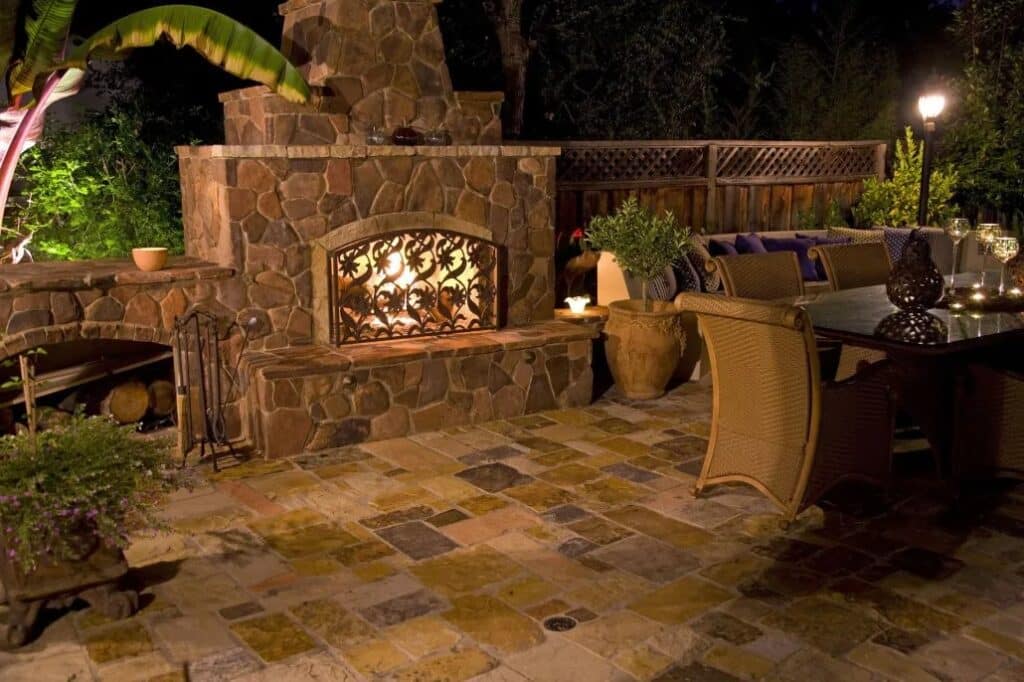
2. Natural Stone Surround Fireplace: Timeless Character for Hillside Estates
Stone fireplaces are Seville’s heritage. We’ve been working with quartzite, travertine, flagstone, and slate across Saratoga and Los Altos Hills properties since 1978, and our conviction hasn’t changed: natural stone is the most enduring finish choice for an outdoor fireplace in this climate.
The material you choose shapes the feel of the space. Travertine — warm, cream-to-gold tones with natural veining — pairs naturally with the Mediterranean and Tuscan-influenced architecture common throughout Los Altos Hills. Quartzite in dark charcoal or steel-blue tones works with contemporary and craftsman homes. Flagstone in earth tones reads as relaxed and organic, fitting for hillside estates with mature landscaping.
All stone applications on a Seville fireplace are properly sealed for Bay Area conditions: coastal moisture, occasional hillside freeze events, and the thermal cycling that happens when a fireplace runs regularly. Stone installed without the right sealer won’t look the same in five years. Stone installed correctly looks better every year.

3. Modern Linear Fireplace: Clean Lines for Contemporary Silicon Valley Architecture
Not every outdoor fireplace should have an arch. If your home is contemporary — clean rooflines, glass and concrete, geometric forms — a traditional arched fireplace will read as a mismatch no matter how well it’s built.
A modern linear fireplace solves this. The horizontal gas flame runs the full width of a low, wide firebox, with a surround in slate, large-format porcelain tile, or board-formed concrete. The result is architectural — it looks like it belongs there, not like it was borrowed from a different home’s design vocabulary.
We’ve built linear fire features as wall elements in Atherton outdoor living areas where the entire back wall of the patio was designed as a single material plane: stone, storage, and a horizontal gas flame integrated into one cohesive structure. That’s the design thinking that separates a contractor who understands the full space from one who only builds the fireplace.
4. Outdoor Fireplace + Outdoor Kitchen: The Full Entertaining Suite
This is the combination we hear most often from clients who’ve done their research: they want fire on one end of the patio and a full outdoor kitchen on the other. It’s the setup that makes outdoor entertaining actually function like indoor entertaining — guests move naturally between the cooking area and the fire, and the evening has a shape to it.
The typical layout puts the outdoor kitchen near the house (close to utility runs and easy service access) with the fireplace anchoring the far end of the patio, creating a defined gathering point. Between them, a dining area or lounge zone completes the circuit.
The best evenings flow from an outdoor kitchen to a fire-lit space without the party losing its energy. A Los Altos Hills project we built included a full U-shape kitchen pavilion with a louvered pergola, and fire features positioned to anchor the outdoor room — the kind of setup where guests genuinely don’t want to leave.
If you’re considering both, plan them together. The utility infrastructure (gas, electrical) runs once; the patio layout makes more sense when both anchor points are designed in relationship to each other. Explore our outdoor kitchen designs →
5. Covered Patio Fireplace: Extending the Outdoor Season
Bay Area weather is mild by national standards, but “mild” doesn’t mean warm. Saratoga and Los Altos Hills evenings drop significantly after sunset — 15 to 20 degrees is common in spring and fall — and coastal fog pushes into the inland valleys several nights per week in summer.
A covered patio with a built-in fireplace is the solution that makes the outdoor space usable across a genuinely extended season. The roof keeps the fire visible and effective in light rain; the fireplace holds the ambient temperature at the comfortable side of cool.
Two things are important to know about covered patio fireplaces: they require adequate clearance between the firebox and any overhead structure per California building code, and any permanent covered structure will require a building permit. Proper ventilation design is part of every Seville covered patio fireplace project — it’s not an afterthought.
6. Corner Fireplace: A Focal Point on Smaller Patios
Not every luxury home in Saratoga or Los Altos Hills has a sprawling, flat outdoor area. Hillside lots, suburban setbacks, and sloped terrain can constrain patio footprints considerably. A corner outdoor fireplace handles these sites well.
Positioned in a corner of the patio, the fireplace creates a defined focal point without requiring a central footprint. Wings of masonry or built-in bench seating on each side of the corner frame the space and make the fireplace feel like the room’s organizing element — which, in a smaller outdoor area, it genuinely is. A gas corner fireplace with stone veneer and integrated bench seating can make a 300-square-foot patio feel like a complete outdoor room.
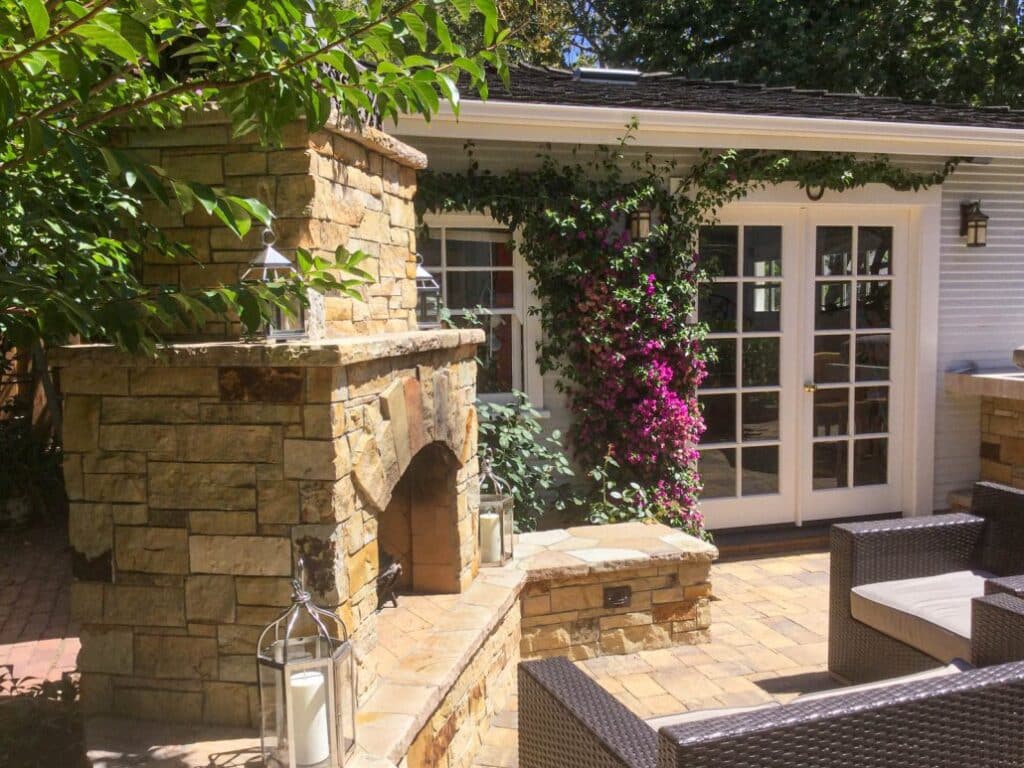
7. Stone Arch Fireplace: The Classic Statement Piece
Some homes call for a traditional outdoor fireplace, and there’s no reason to talk them out of it. Craftsman, ranch, and Tuscan-style properties — all common in Saratoga and Los Gatos — are where stone arch fireplaces belong. The arched firebox, the coursed stone or brick surround, the substantial chimney: this is a design that has looked right for a long time and will continue to look right.
The materials that hold up best in Bay Area conditions: hand-laid brick with a properly weathered mortar joint, natural fieldstone in buff or grey tones, or cast stone veneer over a concrete masonry unit (CMU) structure. Seville has been building stone arch outdoor fireplaces since 1978 — these are often the projects that clients photograph and send us photos of ten years later.
What to Consider Before Installing an Outdoor Fireplace
A few planning points that save our clients time and frustration:
Permits. Nearly every Bay Area city requires a building permit for a permanent outdoor fireplace. Plan 4–8 weeks for permit review before construction can begin — especially if your project includes a covered structure. We manage the permitting process as part of every Seville outdoor living project.
Fuel choice. Gas is the practical choice for BAAQMD compliance and year-round usability. Some clients prefer a wood-burning fireplace for specific aesthetic or functional reasons — we can discuss the tradeoffs on a site-by-site basis.
Site conditions. Gas line access, proximity to the house, patio elevation, and slope all affect the design and cost of the project. We assess every site individually before quoting.
Contractor accountability. Outdoor fireplaces involve multiple trades — masonry, gas, electrical, potentially structural permitting. We handle all of it in-house with no subcontractors, which means one point of contact and one crew responsible for the complete result. California requires a C-27 Landscaping Contractor’s License for this scope of work — the California Landscape Contractors Association maintains licensing standards and a contractor directory if you’re vetting options.
Outdoor Fireplace FAQ
What type of outdoor fireplace works best in the Bay Area?
Gas. The Bay Area Air Quality Management District’s Spare the Air program restricts wood-burning on alert days throughout the region, which are common in fall and winter. A gas fireplace gives you a year-round fire feature with no alert-day restrictions and no ash cleanup.
Do I need a permit for an outdoor fireplace in California?
Yes — in most Bay Area cities, a permanent outdoor fireplace requires a building permit. The process involves submitting construction plans and waiting for local plan review, which typically takes 4–8 weeks. Seville manages permitting as part of every project.
How long does it take to build a custom outdoor fireplace?
A custom built-in outdoor fireplace typically takes 3–5 weeks from groundbreak to completion, including foundation, masonry, gas rough-in, and finish work. Permitting adds time before construction begins, so planning early — especially if your entertaining season starts in April — is smart.
Can an outdoor fireplace be added to an existing patio?
Often, yes — it depends on the patio’s footprint, proximity to the home, and whether a gas line can be routed cost-effectively. We assess every site individually. Starting a conversation now gives us time to permit and build before summer and fall entertaining.
Bring Your Outdoor Fireplace Vision to Life in Saratoga and Los Altos Hills
Seville Landscape Construction has been designing and building custom outdoor fireplaces across the South Bay since 1978. Every project is built by our in-house team — no subcontractors, no handoffs, no gaps in accountability.
Our outdoor living projects start at $20,000. Outdoor fireplaces are often designed as part of a larger patio and outdoor kitchen project, though we do build standalone fireplace installations as well.
If you’re in Saratoga or Los Altos Hills — or anywhere in the South Bay — we’d like to see your site and talk through what’s possible. Learn more about hardscaping in Saratoga →
Call us at (408) 732-2867 or fill out the contact form on this page to get started.
You’re Serious. We’re Serious.
Get Started With Luxury Landscaping Design Today
Here’s what serious looks like: our minimum starting price for a project is $20,000, and adjusts to encompass residential projects of any size. Tell us about your project, and we’ll give you a call. We’ll work from your blueprints or create a design from scratch in consultation with you. We look forward to talking to you about your vision for the perfect outdoor living space.